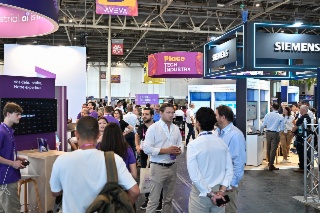
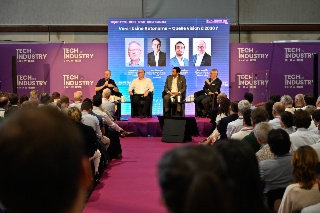
Five innovations drive Industry 4.0: generative AI, digital twins, industrial IoT, collaborative robotics and sustainable manufacturing. The article illustrates them with examples from Siemens and Microsoft, Renault Group and Dassault Systèmes, McKinsey, Universal Robots, HP and Schneider Electric. Tech for Industry Show presents these technologies and the people who build them.
In 2025, industry is no longer just connected: it is becoming intelligent, predictive and sustainable. Industry 4.0 continues to redefine how factories design, produce and interact with their environment. Behind the machines, a human and technological revolution is gathering pace, and Tech for Industry Show is here to shine a light on it. Here are the five most significant innovations shaping the industry of tomorrow.
1. Generative AI at the heart of factories
AI no longer just analyzes data: it creates. In 2025, factories use generative AI to design new prototypes, anticipate failures and optimize production lines in real time.
At Siemens, the Industrial Copilot developed with Microsoft brings generative AI capabilities directly into industrial environments. On the packaging lines of Sollas, this technology increased throughput by 33% through automatic optimization of machine cycles.
(Source: Siemens, 2024)
2. Digital twins: the mirror factory
Every machine, every process, every logistics flow now has its virtual double. A digital twin makes it possible to simulate the impact of a decision before implementing it, adjust a production cycle or detect a breakdown before it happens.
Dassault Systèmes is working with Renault Group through the 3DEXPERIENCE platform to create “virtual twin experiences” of their plants, accelerating digital transformation and industrial flexibility.
(Source: Renault Group & Dassault Systèmes, 2023)
3. Next-generation industrial IoT
Connected devices no longer just report data: they interpret it and act on it.
According to McKinsey & Company, industrial IoT represents an annual economic potential of $1.6 trillion by 2030, driven in particular by energy optimization and predictive maintenance.
(Source: McKinsey, 2023 - “The Internet of Things: Value set to accelerate through 2030”)
4. Augmented collaborative robotics
“Cobots” no longer replace humans: they augment them. Equipped with 3D vision and embedded AI, they adapt to operators’ movements and needs.
With Universal Robots, some factories have recorded productivity gains of up to 400% in plastic molding thanks to human-machine collaboration.
(Source: Universal Robots Case Study - AIM Processing, 2023)
5. Sustainable and circular manufacturing
Industrial innovation is no longer measured by performance alone, but also by its environmental impact.
HP has developed 3D printing materials that allow up to 80% powder reuse in its additive manufacturing ranges, significantly reducing waste.
For its part, Schneider Electric is rolling out its Zero Carbon Project to cut 50% of its direct suppliers’ emissions by 2025.
(Sources: HP 3D Printing Materials, 2024; Schneider Electric Sustainability Report, 2024)
What about tomorrow?
Industry 4.0 in 2025 is not a distant horizon: it is a reality unfolding before our eyes. Each innovation opens the door to a more agile, more connected and more conscious industry.
The Tech for Industry Show will be the place to see these technologies in action, meet the people who invent them and, perhaps, imagine the fifth industrial revolution together.
Frequently asked questions
What gain did Siemens' Industrial Copilot deliver?
On Sollas packaging lines, the Industrial Copilot developed by Siemens with Microsoft increased throughput by 33% through automatic optimization of machine cycles.
What is a digital twin used for in Industry 4.0?
It makes it possible to simulate the impact of a decision before implementing it, adjust a production cycle or detect a breakdown before it happens. Dassault Systèmes and Renault Group create virtual twins of plants on the 3DEXPERIENCE platform.
What is the economic potential of industrial IoT?
According to McKinsey, industrial IoT represents an annual economic potential of $1.6 trillion by 2030, driven in particular by energy optimization and predictive maintenance.