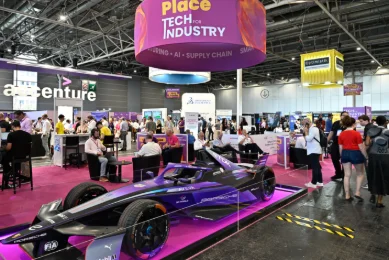
In the automotive industry, AI is first put to work in plants: camera-based quality inspection, maintenance, line management, robots and supply planning. The manufacturers that report quantified results first connected their equipment and structured their data. Renault, Stellantis and Forvia described this at Tech for Industry Show 2026.
Why the automotive industry is speeding up on AI in plants
The manufacturers at the show described the same constraints: shorter development cycles, several models on a single line and an unstable supply chain. Stellantis plans 60 new products by 2030, with development cycles of around two years, a pace it considers "almost impossible" to sustain without AI. Renault monitors more than 40,000 tier N suppliers, with at least one major alert every week. Its Douai plant assembles more than 1,000 vehicles a day on a single line, for several models.
Use is growing across industry. According to Insee, the French statistics office (Insee Première no. 2120, 21/07/2026), 17% of manufacturing companies in France used at least one AI technology in 2025, compared with 7% in 2024. Among companies with 250 employees or more, across all sectors, the share reaches 58%.
AI use cases in an automotive plant
- Vision-based quality inspection: cameras and AI models check the presence, position and appearance of parts on the line. Our machine vision guide describes this use.
- Sound-based inspection: Forvia has inspected parts by vision and by sound, using machine learning, for more than five years.
- Maintenance: predicting failures from machine data and helping technicians diagnose faster. Forvia aims to cut mean time to repair by 50% across 5,000 machines.
- Line management: querying production data in natural language, spotting a bottleneck, adjusting a parameter.
- Robotics: models that perceive the robots' surroundings, and the first humanoid robots in production.
- Supply chain: transport plans, supplier alerts, forecasts, with AI agents preparing decisions.
- Engineering: simulations, first designs and responses to carmakers' calls for tender, prepared faster.
The foundation: connecting equipment and structuring data
At the 2026 show, Renault described around 25,000 connected pieces of equipment in its plants, producing some 5 billion data points a day. The group has written around 80 reusable process data models. The screwdriving model, for example, applies to 2,000 to 3,000 screwdrivers from different brands and describes the whole operation: equipment, operator, workstation, applied torque, result. In an article published on 25/11/2024, Renault Group put the savings delivered by more than 300 projects of its industrial metaverse since 2019 at 700 million euros.
Forvia makes the same point: its future MES is built around a common model of operations, based on the ISA-95 standard. A language model can make up for naming inconsistencies during a trial, but it gets lost at scale. Our article on industrial data details this preparation.
Quality: camera inspections at the scale of every plant
Renault builds its AI visual inspections on an in-house platform rather than on solutions bought plant by plant. The target presented at the show was 500 inspections per plant by the end of 2025 and 1,000 by the end of 2027. The group has also cut the time needed to detect a quality defect at customers from two months to less than two days, by cross-referencing breakdown data with a digital passport for each vehicle.
BMW Group is testing another approach at its Regensburg plant, which produces around 1,400 vehicles a day. According to the group's press release of 28/04/2025, the GenAI4Q pilot project generates for each vehicle an inspection catalogue tailored to its configuration, before the final inspection.
Robots: from perception to humanoids
Renault has more than 11,000 industrial robots. At the show, the group presented the humanoid robot Calvin, designed with Wandercraft, which is being tested in night-shift production at the Douai plant to handle tyres, with a two-minute cycle time. It aims for 350 humanoid robots in 2027. For Wandercraft, the decisive criterion is reliability: at least 999 successful cycles out of 1,000, far more than agility.
Supply chain and AI agents
At the show, Stellantis described its Optima tool: across some forty plants and hundreds of suppliers, AI builds the inbound transport plan, taking costs, routes and constraints into account. Another agent reads job sheets, detects missing data and creates quality tickets; eleven plants are lined up for its rollout. Stellantis puts the cost of a simple agent at 0.5 to 1 dollar per interaction, and up to 10 dollars for complex agents that orchestrate each other. Our agentic ai supply chain guide describes these agents and their limits.
What the AI Act says
The European AI regulation classifies uses according to their risk. According to the European Commission, its prohibitions have applied since February 2025 and the obligations for high-risk systems apply from 02/12/2027. Two categories cited by the Commission concern the plant: AI-based safety components of products, and AI tools used to manage workers. A model that controls a safety function of a robot or that assesses operators therefore needs to be analysed before it is deployed.
How to launch an AI project in an automotive plant
- Start from a quantified problem: scrap, stoppages, repair time, time to detect a defect.
- Connect and structure before modelling: data models shared by all equipment of the same type.
- Build a platform that can be reused from one plant to the next rather than buying site by site.
- Give shop floor teams access: at Renault, around 7,000 self-service users.
- Keep humans in the decision: the agent proposes, an operator validates.
- Measure the value and the cost of each model and each agent.
What manufacturers said at Tech for Industry Show
Renault Group and Accenture traced eight years of transformation: more than 120 million euros of estimated value, the ramp-up of a new model cut from twelve to six months and a laser cladding line developed in five days with AI agents. Read the article
Renault and Wandercraft presented Calvin, the humanoid robot in production in Douai. Read the article
Stellantis, Microsoft and Accenture detailed Stellantis's AI agents, from engineering to after-sales, and how their value is measured. Read the article
Forvia, Safran and Renault presented their roadmap towards the autonomous factory of 2030. Read the article
Forvia explained how its approach, tested in pilot plants, was extended to its 240 plants and delivers tens of millions of euros in gains a year. Read the article
Tech for Industry Show 2027 exhibitors on this topic
- Optimistik, publisher of the OIAnalytics industrial data platform, which spoke at Forvia's round table at the 2026 show.
- Azumuta, a platform for work instructions and quality control on the shop floor, used by Toyota on its European lines to manage more than 600 accessories; its AzumutaLab tool generates instructions from a video.
- Kbrw, a French publisher of an agentic supply chain execution engine, which lists Stellantis among its customers.
Frequently asked questions
What is AI used for in an automotive plant?
Camera-based quality inspection, maintenance, line management, robotics and supply chain planning.
Is structured data needed before launching AI?
Yes: Renault and Forvia first connected their equipment and defined common data models, without which a model gets lost at scale.
Are humanoid robots already in production?
Renault is testing the Calvin robot in night-shift production in Douai and aims for 350 humanoid robots in 2027.
How much does an AI agent cost?
According to Stellantis, 0.5 to 1 dollar per interaction for a simple agent, up to 10 dollars for complex agents.
Does the AI Act apply to plants?
Yes, for some uses: according to the European Commission, AI-based safety components and worker management tools are high-risk, with obligations from 02/12/2027.
Further reading
Our industrial ai page brings together the show's talks, articles and exhibitors on this topic.