Automated storage covers the systems that store and retrieve loads without a driver or forklift operator: stacker cranes for pallets, miniloads and shuttles for totes, vertical storage units, grids served by robots. Software decides where to store each load and brings it back to the picking station. The choice depends first on the load, pallet, tote or part, then on the number of movements per hour and the available height.
What automated storage is for
- Using height. Mecalux states that its stacker cranes reach up to 45 m in aisles about 1.5 m wide.
- Removing picking errors. The software knows where each load is and brings it to the operator.
- Keeping a steady pace, day and night, between production, storage and shipping.
- Linking the plant to the store. Finished goods pallets can move from the line to the store without a forklift.
Types of automated storage
Pallet stacker crane
A stacker crane is a rail-guided machine that travels along the aisle, lifts the pallet and places it in the rack with its forks. According to Mecalux, it can store one pallet and pick up another in the same trip, which the manufacturer calls a combined cycle. Its range goes from an 18 m model for low-throughput warehouses to 45 m models; a three-way model automates existing racks up to 14 m that were previously served by forklifts. It is the answer for large pallet volumes: finished goods, raw materials, cold stores.
Compact storage with pallet shuttles
Shuttles travel in deep storage channels and place pallets one behind the other. At Mecalux, a stacker crane of up to 12 m serves these shuttles and moves them between channels. This solution targets density, for a small number of SKUs stored in large quantities.
Miniload and tote shuttles
A miniload applies the stacker crane principle to totes, cartons or trays. Shuttle systems use one robot per rack level and a lift at the end of the aisle, for higher throughput. They serve the picking of small parts, components before assembly or spare parts.
Vertical storage: vertical carousel and vertical lift module
A vertical carousel rotates trays like a big wheel. Kardex describes its Megamat as working on the paternoster principle: the requested carrier reaches the access opening by the shortest path. The manufacturer gives a load of 180 to 650 kg per carrier depending on the model and a height of about 2.2 to 10 m. A vertical lift module, or storage tower, stores trays at the height they need and presents them at a station. These units suit parts, tooling, consumables and maintenance spares, close to the shop floor.
Robotic grid storage
Totes are stacked in a grid and robots travel on top to retrieve them. At AutoStore, a bin carries up to 30 kg and the grid holds up to 26 levels of 220 mm bins, 18 of 330 mm bins or 14 of 425 mm bins. Exotec, a French manufacturer, has its robots climb directly into the racks.
Software: WMS, WCS and execution
Automated storage only works with its software. The WMS manages stock, locations and orders. Control or execution software, often supplied by the manufacturer, drives the machines in real time. Two examples:
- At Exotec, the customer's WMS sends picking orders through an application programming interface, and the system picks the fastest robot to handle them, according to Exotec's speakers at Tech for Industry Show 2026. The manufacturer calls its warehouse execution software Deepsky.
- At Alstef, the OPAL suite, presented as a WCS, manages stock and material flows in the Suntory project described below.
Connecting to the existing ERP and WMS is part of the project, and so is its cost.
Safety and standards
- Stacker cranes: the EN 528 standard, "Stacker cranes, safety", sets the requirements specific to these machines.
- Vertical storage units and carousels: the NF EN 15095+A1 standard (February 2009) covers storage lifts, carousels and power-operated mobile racking.
- Machinery: Regulation (EU) 2023/1230 replaces the Machinery Directive from January 2027. Automated storage delivered after that date will have to comply with it.
- Maintenance: work inside the racks and on the machine must be prepared, with energy lockout, because it is when the operator enters the protected area.
How much automated storage costs
Hellopro publishes prices observed in November 2026, to be taken as orders of magnitude:
- Vertical lift module: 35,000 to 150,000 euros.
- Vertical carousel: 40,000 to 350,000 euros.
- Semi-automated pallet shuttle: from 10,000 to 15,000 euros per shuttle, racking extra.
- Miniload for totes and cartons: from about 600,000 euros.
- High-throughput shuttles and pallet stacker cranes: from about one million euros.
The same guide puts maintenance at 2 to 5% of the system's value per year, machine safety at 3 to 8% of the equipment budget, and the WMS or WCS at several tens to several hundreds of thousands of euros.
An industrial example: Suntory in Donnery
In 2023, Suntory Beverage & Food France (Orangina, Oasis, Schweppes) awarded Alstef Group the automation of its new logistics centre next to the Donnery plant, in the Loiret department. The announced contract covers a store of nearly 12,000 m², 48,000 locations served by 36 shuttles on 9 levels, in multi-depth. A loop of 46 carriers links the plant to the store through a gallery, to transfer finished goods pallets as they leave production. Commissioning was announced for the first half of 2025.
The market
According to Fortune Business Insights (report updated on 19/10/2026), the global automated storage and retrieval systems market was worth 9.58 billion dollars in 2025, including 3.06 billion in Europe. The firm forecasts 17.4 billion in 2034. Other firms give very different figures: a market estimate only makes sense with the name of its author.
How to choose an automated storage system
- Start from the load: pallet, tote, carton, part, weight and dimensions. It sets the system family.
- Count SKUs and movements: few SKUs in large quantities call for density (pallet shuttles), many fast-moving SKUs call for throughput (shuttles, grid, miniload).
- Measure the building: clear height, floor, surface. A high-bay project can justify a new building.
- Plan the software: connection to the WMS and ERP, manufacturer software, item data migration.
- Think about breakdowns: redundancy, maintenance, spare parts, on-call service and availability commitment.
- Compare with mobile robots: when flows change often, AMR robots can serve conventional storage without locking in the warehouse layout.
What manufacturers said at Tech for Industry Show
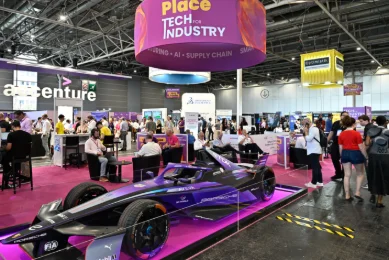
At Tech for Industry Show 2026, Pascal Férard and Jérémie Rozenblum, from Exotec, explained what happens to robotic storage when it carries a whole chain. According to them, Exotec builds its robots in its Wasquehal plant, about 14,000 units are in service, and its systems replenish all of Decathlon's European stores or distribute Renault spare parts to garages in France. A breakdown can therefore stop an assembly line or block orders. Their answer: a master system and a backup system that takes over, three monitoring centres in France, the United States and Japan, and a real-time backup of the stock status. Read the article
Frequently asked questions
What is automated storage?
A set of machines and software that store and retrieve loads without a driver: stacker cranes, shuttles, miniloads, vertical storage units or robotic grids.
What is a stacker crane?
A rail-guided machine that travels in a rack aisle, lifts the load and places it in its location. Mecalux states models up to 45 m high.
What is the difference between a vertical carousel and a vertical lift module?
A vertical carousel rotates all its trays to the opening. A vertical lift module fetches a single tray and presents it at the station.
How much does automated storage cost?
According to prices observed by Hellopro in November 2026, from about 35,000 euros for a vertical lift module to more than one million euros for a pallet stacker crane or high-throughput shuttles.
Do you need a WMS?
In practice, yes: the WMS manages stock and orders, the manufacturer's software drives the machines.
Further reading
Our supply chain 4.0 page brings together the show's talks, articles and exhibitors on this topic.