A palletising robot is a robotic arm that automatically stacks cartons, bags or cases onto a pallet at the end of the line, following a programmed pallet pattern. It is chosen first according to the weight and format of the packages, the throughput and the number of product references: a dedicated four-axis robot, a heavy six-axis robot or a cobot. According to the French marketplace Hellopro, a new palletising robot costs 70,000 to 500,000 euros (November 2026).
Robotic or conventional: two ways to palletise
- The conventional palletiser forms complete layers, then places them on the pallet. Honeywell, which makes both types, recommends it for high-speed operations; it is common in food and beverages.
- The palletising robot picks packages one by one or in small groups. Again according to Honeywell, it suits sites that handle many different references, often at lower speeds, with little equipment around the robot.
The choice therefore depends on the product mix more than on throughput alone.
The three families of palletising robots
- The four-axis robot dedicated to palletising. FANUC lists it in a range of palletising robots. Example: the FANUC M-410iC/185, a four-axis robot with a 185 kg payload and a 3,143 mm reach.
- The heavy six-axis robot in a palletising version. It handles very heavy loads. Example: the KUKA KR 1000 titan, a six-axis robot offered in a palletising version with up to 1,300 kg of payload and a 3,202 mm reach.
- The palletising cobot. It works next to operators, for lighter packages and lower speeds. On 26/09/2024 Universal Robots raised the payload of its UR20 and UR30 to 25 and 35 kg, gripper included, in top lift position, with palletising in mind. FANUC states a 30 kg payload and a 1,756 mm reach for its CRX-30iA, and up to 40 kg for palletising.
To compare the major arm brands, see our article on industrial robot manufacturers.
What a palletising cell includes
The robot is only part of the cell. Around it, the integrator adds:
- The gripper, suited to the product: suction cups for cartons, clamp or fork for bags, a combined tool to also place empty pallets and slip sheets.
- The conveyors that bring in packages and take away full pallets.
- The empty pallet magazine and the slip sheet dispenser.
- Pallet wrapping, often at the cell exit.
- Guarding: fences, safety scanners or light curtains, depending on the risk assessment.
- The pallet pattern software, used to create a new stacking pattern when a new reference arrives.
Safety and standards
- The ISO 10218-1 and ISO 10218-2 standards, revised and published in February 2025, set the safety requirements for industrial robots (part 1) and for industrial robot applications and robot cells (part 2). Part 2 directly concerns a palletising cell.
- Regulation (EU) 2023/1230 on machinery applies from January 2027. A palletising cell put into service from that date falls under it.
- The split of roles: the manufacturer supplies the robot, which is partly completed machinery; the integrator designs the cell and declares the conformity of the final machine.
- The cobot can work without a physical barrier if the risk assessment allows it; this is the subject of our guide on the cobot.
How much does a palletising robot cost?
The French marketplace Hellopro reports the following ranges in November 2026:
- New palletising robot: 70,000 to 500,000 euros depending on payload, reach, gripper and safety options.
- Automatic palletiser (conventional, integrated into an end of line): 100,000 to 350,000 euros.
- Integration of a complete cell (conveyors, pallet magazine, slip sheets, wrapping, safety, installation): often 10,000 to 50,000 euros more.
- Maintenance: 5,000 to 20,000 euros per year.
- Used equipment: 15,000 to 200,000 euros, depending on condition, year and the adaptations needed.
The quote depends mainly on throughput, product type, pallet formats, gripper and the number of lines to serve.
How to choose a palletising robot
- The packages: heaviest weight, gripper included, formats, fragility, bags or cartons.
- Throughput: packages per minute to handle on each line, and how many lines one robot can serve.
- References: number of pallet patterns and how often products change.
- Pallet height and format, which set the reach needed.
- Floor space and how operators work around the robot, which point to a guarded cell or to a cobot.
- Service: an integrator close to the site, spare parts, training teams to create new patterns.
What manufacturers said at Tech for Industry Show
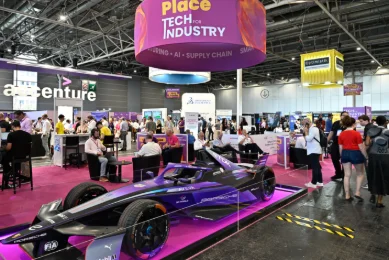
At Tech for Industry Show 2026, at Paris Expo Porte de Versailles, Renault and Wandercraft presented Calvin, a humanoid robot tested in production at the Douai plant. Its first use is handling tyres of 12 to 15 kg at the end of the line: an arduous task that Renault considers hard to automate with conventional robots, since, according to the carmaker, it would take 4 to 6 traditional robots. Read the article
For the mobile robots that feed or clear ends of line, our AMR and AGV robots guide presents these technologies.
Frequently asked questions
What is a palletising robot?
A robotic arm that automatically stacks packages onto a pallet at the end of the line, following a programmed pallet pattern.
What is the difference between a conventional palletiser and a palletising robot?
The conventional palletiser forms complete layers and targets high speeds; the robot picks packages one by one and adapts better to many references.
How much does a palletising robot cost?
From 70,000 to 500,000 euros for a new robot according to Hellopro (November 2026), plus 10,000 to 50,000 euros of integration for a complete cell.
Can a cobot palletise?
Yes, for light packages and moderate speeds: Universal Robots states 25 and 35 kg for its UR20 and UR30, FANUC up to 40 kg for palletising with its CRX-30iA.
Which standards apply to a palletising cell?
The ISO 10218-1 and ISO 10218-2 standards, revised in 2025, and from January 2027 Regulation (EU) 2023/1230 on machinery.
Further reading
Our industrial robotics page brings together the show's talks, articles and exhibitors on this topic.