The major industrial robot manufacturers are Japanese (FANUC, Yaskawa, Kawasaki, Denso, Epson), European (ABB, KUKA, Stäubli, Universal Robots, Comau) and, increasingly, Chinese (Estun, Siasun). In China, the world's largest market, Chinese manufacturers now sell more robots than foreign brands. France also has manufacturers, mainly in cobots and warehouse robots.
The market in a few figures
According to the World Robotics 2026 report of the International Federation of Robotics (IFR), published on 24/09/2026:
- 5 million industrial robots were operating in factories worldwide at the end of 2025, 9% more than a year earlier.
- More than 600,000 robots were installed in 2025, an increase of 11%.
- China installed 354,000, or 59% of global installations. Chinese manufacturers sold 195,000 robots there, 55% of their home market, compared with 57% in 2024.
- The United States moved up to second place worldwide, ahead of Japan (36,219 robots installed, down 19%).
- France installed almost 4,500 robots (down 8%), the third European market behind Germany and Italy (about 7,800).
Japanese manufacturers
- FANUC: founded in 1972, headquartered in Oshino-mura, at the foot of Mount Fuji. Its first robot dates from 1977. In August 2023, FANUC passed the mark of one million industrial robots shipped in 46 years. The range covers articulated arms of all sizes, SCARA and delta robots for assembly and high-speed picking, and the CR and CRX cobot series.
- Yaskawa: founded on 16/07/1915, headquartered in Kitakyushu. The group makes robots as well as drives and servomotors, the components that power machine axes.
- Kawasaki: the first to produce an industrial robot in Japan, in 1969, under licence from the American company Unimation. Its range runs from painting and welding robots to cleanroom robots and duAro, a dual-arm SCARA.
- Denso: the robotics arm of the automotive supplier has been developing robots since 1967. It specialises in small assembly robots, from four-axis SCARA to five- and six-axis articulated arms: more than 20,000 run in its own plants and more than 80,000 at other manufacturers.
- Epson: more than 250,000 robots deployed worldwide, first designed for its own automation needs. The brand is known for its SCARA robots and also offers six-axis robots and cobots.
European manufacturers
- ABB: the Swiss group announced on 08/10/2025 the sale of its robotics division to SoftBank Group for about 5.4 billion dollars, with completion expected between mid and late 2026.
- KUKA: its history begins in 1898 in Augsburg, where the company is still headquartered. In 1973, its Famulus robot was the world's first industrial robot with six axes driven by electric motors. Since January 2017, KUKA has been controlled by the Chinese group Midea, which holds 94.55% of its voting rights.
- Stäubli: a Swiss group founded in 1892 in Horgen, present in France since 1909 in Faverges, Haute-Savoie. It entered robotics by acquiring the American company Unimation, a pioneer of articulated arms, then took over the robotics business of Bosch Rexroth to complete its range of four- to six-axis robots.
- Universal Robots: founded in 2005 in Odense, Denmark, by three researchers from the University of Southern Denmark, acquired in 2015 by the American company Teradyne for 285 million dollars. The company passed 100,000 cobots sold in 2025. To understand what sets a cobot apart from a conventional industrial robot, see our guide.
- Comau: formed in 1973 in Turin from a group of small companies supplying machinery to the Fiat Group, Comau is headquartered in Grugliasco, near Turin.
Chinese manufacturers
- Estun: founded in 1993 and listed in Shenzhen, Estun started with servomotors before developing its own industrial robots, built on its in-house components.
- Siasun: founded in 2000, Siasun makes industrial robots, mobile robots and special robots, with three application areas: welding, assembly and logistics.
The rise of these brands shows in the IFR figures: in 2025, more than one robot in two installed in China came from a Chinese factory.
French manufacturers
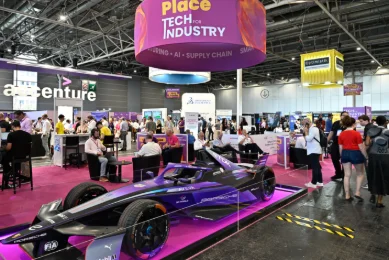
- Exotec, in Wasquehal (northern France), designs and builds its warehouse robots in its French plant, which is also its headquarters. At Tech for Industry Show 2026, the company said it had about 14,000 robots in operation. Read the article
- Niryo, in Wambrechies, near Lille, has been designing and building collaborative robots for education and industry since 2017. In January 2026 its founder reported about fifty employees and arms sold in 60 countries (La Gazette France, 22/01/2026).
- Stäubli, a Swiss group, has had its first production site outside Switzerland in Faverges, France, since 1909.
For mobile robots in warehouses and plants, our AMR and AGV robots guide presents these technologies.
Manufacturer or integrator: who to contact?
The manufacturer supplies the robot, meaning the arm, its controller and its software. Under machinery safety rules, it is partly completed machinery. The integrator designs the cell around it that performs the task: end-of-arm tool, guarding, conveyors, programming, commissioning. The integrator declares the conformity of the final machine. Most projects therefore go through an integrator, who works with one or several brands. The choice of a brand is often made at the same time as the choice of integrator.
How to compare brands
- Payload and reach: from a few kilos for small-part assembly to several hundred kilos for heavy handling.
- Robot type: six-axis articulated arm for versatility, SCARA for fast assembly on a plane, delta for very high-speed picking, cobot for working next to operators.
- Applications planned by the manufacturer: welding, painting, cleanroom, food, palletising.
- Service: local support and spare parts, training, how long models are supported.
- Software: programming language, simulation, compatibility with the PLCs and vision systems already in the plant.
- Available integrators near the site, since they are the ones who will run the cell.
How much does an industrial robot cost?
Manufacturers rarely publish their prices online. The French marketplace Hellopro reports, in November 2026, prices for new articulated robots of 10,000 to 60,000 euros for a four-axis robot, 25,000 to 90,000 euros for a six-axis robot, and 60,000 to 200,000 euros from seven axes upwards. These are robot prices. A complete cell adds the tool, safety, integration and commissioning.
What manufacturers said at Tech for Industry Show
At Tech for Industry Show 2026, at Paris Expo Porte de Versailles, a round table brought together NVIDIA, Exotec, Michelin, Accenture and Dassault Systèmes on physical AI, which makes it possible to move from coding a robot to training it. Michelin described the shift from high-performing but deterministic automation to controlled autonomy. Read the article
Renault presented the humanoid robot designed with Wandercraft and tested in production in Douai. Read the article
The talk "From the connected factory to the automated warehouse: robotics at the heart of Industry 4.0" is available as a replay.
Frequently asked questions
Who is the largest industrial robot manufacturer?
The IFR does not publish an official ranking by manufacturer. FANUC states that it has shipped more than one million industrial robots since 1977, the highest cumulative figure published by a manufacturer among those in this article.
Which industrial robot brands are Japanese?
FANUC, Yaskawa, Kawasaki, Denso and Epson, among others.
Are there French industrial robot manufacturers?
Yes, mainly in niches: Exotec for warehouse robots, Niryo for cobots. Stäubli, a Swiss group, has produced in France since 1909.
Is KUKA German or Chinese?
KUKA is headquartered in Augsburg, Germany, and has belonged to the Chinese group Midea since January 2017.
How much does an industrial robot cost?
From 10,000 to 200,000 euros depending on the number of axes according to Hellopro (November 2026), excluding tool, safety and integration.
Further reading
Our industrial robotics page brings together the show's talks, articles and exhibitors on this topic.