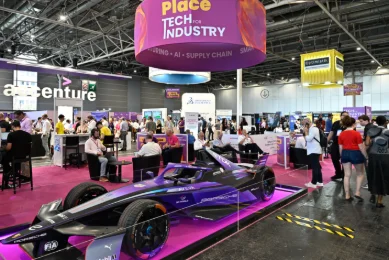
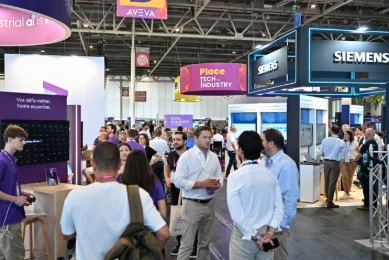
In the food industry, AI is used in plants to inspect quality, anticipate breakdowns, stabilise processes, forecast demand and check labels. The manufacturers that talk about results first put their data and processes in order. Bel, Danone, Nestlé, Pernod Ricard and Bonduelle described this at Tech for Industry Show 2026.
Where industry stands
AI use is growing fast in industry. According to Insee, the French statistics office (Insee Première no. 2120, 21/07/2026), 17% of manufacturing companies in France used at least one AI technology in 2025, compared with 7% in 2024 and 5% in 2023. The European Union average for manufacturing was also 17% in 2025. Insee does not publish a rate specific to the food industry. It notes a common obstacle: more than half of the companies using AI say they lack expertise.
What makes a food plant different
- A living raw material: its quality varies from one batch and one season to the next, and line settings have to follow.
- Campaigns and seasonal workers: at Bonduelle, plants are in the middle of the fields, less than 4 hours from the harvest, and hundreds of seasonal workers are reassigned day by day depending on the weather and breakdowns.
- Perishable products: producing too much creates waste, producing too little creates stock-outs.
- Recipes and formulations: every ingredient change affects the formula, the label and the process.
- Food safety and labelling: allergens, nutrition information and batch traceability are inspected.
AI use cases in a food plant
- Vision-based quality inspection: cameras and AI models spot defects in appearance, filling or packaging on the line. Our machine vision guide describes this use.
- Maintenance: Danone says it uses digital tools that help its teams anticipate equipment issues through predictive maintenance and optimise production parameters, while keeping human expertise in control (FoodNavigator, 19/06/2026).
- Process control: Nestlé uses AI to optimise its processes in real time, detect deviations earlier and stabilise its lines (same source).
- Demand forecasting and planning: models that combine sales history with other factors to limit overproduction and stock-outs. Our supply chain software guide compares the tools.
- Energy and losses: Nestlé analyses its material flows, quality losses and energy consumption to react faster to waste.
- Labelling and compliance: AI can compare ingredient lists, allergen declarations and nutrition information with the rules in force, according to the software publisher Loftware quoted by FoodNavigator.
- Traceability: linking each batch to its materials, its line and its inspections. Our industrial traceability guide details the obligations and technologies.
- R&D and formulation: simulating the effect of an ingredient change on the formula and the finished product, as Pernod Ricard, Danone and Infor described at the show.
- Teams: scheduling, skills and training, with tools that help operators without replacing them.
The foundation: data and processes in order
At the 2026 show, Bel Group, the cheesemaker behind The Laughing Cow and Babybel, presented 25 major digital transformations over six years. The group is replacing 650 legacy platforms with a single foundation made up of an ERP, a PLM and an MES. Its data team grew from 5 to 55 people in three years. Bel also found that 95% of its core processes were not mapped, even though "artificial intelligence does not work very well without structured processes". It is working with Dassault Systèmes on a virtual twin.
Pernod Ricard and Danone make the same point about product data: recipes, formulations, packaging and specifications must be reliable in the PLM before AI is plugged into it. If upstream data is fragile, AI only amplifies that fragility. Our article on industrial data details this preparation.
Manufacturer examples
- Nestlé: at the 2026 show, the group said it started as early as 2019 with models forecasting commodity prices (coffee, cocoa, sugar), whose predictions are 50% better than those of the human expert. Around 1,000 AI agents optimise decisions, and an analysis that used to take three weeks now takes 30 seconds. According to FoodNavigator, Nestlé has also deployed plant digital twins with Accenture Song, and its forecasts made it possible to bring forward production of cold coffee concentrates and add packaging capacity for premium pet food.
- Danone: besides predictive maintenance, the group trains its teams in AI with Microsoft through its DanSkills programme, which covers digital twins and predictive maintenance among other topics (FoodNavigator, 19/06/2026).
- PepsiCo: with Siemens and NVIDIA, the group is testing digital twins and AI agents in the United States to design its production sites and warehouses. PepsiCo says they make it possible to identify up to 90% of potential issues before construction and to cut capital expenditure by up to 15%; these are the company's figures.
- Bel: a single ERP, PLM and MES foundation, a data team multiplied by eleven in three years and process mapping carried out with around 100 process owners.
What the AI Act says
The European AI regulation classifies uses according to their risk. According to the European Commission, its prohibitions have applied since February 2025 and the obligations for high-risk systems apply from 02/12/2027. Two categories cited by the Commission concern the plant: AI-based safety components of products, and AI tools used to manage workers. A tool that assigns or assesses operators, seasonal workers included, therefore needs to be analysed before it is deployed.
How to launch an AI project in a food plant
- Start from a quantified problem: material losses, line stoppages, scrap, stock-outs, labelling errors.
- Map the processes involved before choosing a tool.
- Make data reliable: recipes and specifications in the PLM, line data in the MES.
- Start with one plant or one line, then extend: Danone integrated its bills of materials in one plant, then ten, before considering all 200.
- Keep humans in the decision: the model proposes, the team validates.
- Train shop floor teams, as Danone does with DanSkills.
What manufacturers said at Tech for Industry Show
Bel Group presented its 25 digital projects, its ERP, PLM and MES foundation and its data foundations. Read the article
Pernod Ricard, Danone, Infor and Accenture explained why PLM is the prerequisite for reliable AI in R&D, all the way to AI agents. Read the article
Nestlé, Renault and Latecoere compared their roadmaps towards the autonomous supply chain. Read the article
Bonduelle, LVMH Beauty and Aubert & Duval showed how data changes team assignment and the operator's job. Read the article
Tech for Industry Show 2027 exhibitors on this topic
- Poka, an industrial AI platform for frontline workers, which lists Nestlé, Mars, Danone and Tetra Pak among its customers; Poka is part of the IFS group.
- Elisa Industriq, a publisher of demand management, planning, scheduling and MES solutions, which lists Panzani, Altho Bret's, Campari and Bauli among its customers.
Frequently asked questions
What is AI used for in a food plant?
Camera-based quality inspection, maintenance, process control, demand forecasting, labelling, traceability and formulation.
What share of industry uses AI?
According to Insee, 17% of manufacturing companies in France in 2025, compared with 7% in 2024. Insee does not publish a rate specific to the food industry.
Is structured data needed before launching AI?
Yes: Bel first rebuilt its ERP, PLM and MES foundation and mapped its processes, and Pernod Ricard and Danone are making their product data reliable in the PLM.
Which food manufacturers use AI?
Among others, Nestlé, Danone, PepsiCo and Bel, for forecasting, maintenance, digital twins and formulation.
Does the AI Act apply to food plants?
Yes, for some uses: according to the European Commission, AI-based safety components and worker management tools are high-risk, with obligations from 02/12/2027.
Further reading
Our industrial ai page brings together the show's talks, articles and exhibitors on this topic.