A welding robot is a robotic arm, most often with six axes, that carries a torch or a gun and makes welds according to a program, with the same path and parameters from one part to the next. It is chosen first according to the process (arc, spot, laser), the size of the parts and the batch volume: an industrial robot in a guarded cell for large series, a cobot for small, varied batches. According to the French marketplace Hellopro, a robotic cell costs on average 50,000 to 300,000 euros (prices seen in November 2026, all applications combined).
Why automate welding
- Recruitment. In France Travail's 2026 Labour Needs survey (BMO), employers plan 5,030 welder recruitment projects in France, 71.2% of which are considered difficult.
- Small batches. Welding equipment maker Kemppi notes that small and medium-sized companies welding low volumes of varied parts often struggle to find manual welders.
- Health. According to INRS, the French occupational safety institute, which cites the 2017 Sumer survey, 528,000 employees, about 2% of French employees, are exposed to welding fumes. The robot keeps the operator away from the weld.
- Consistency. A program repeats the same path, speed and parameters on every part.
Processes welded by robots
- MIG/MAG arc welding, with a consumable wire fed continuously through the torch.
- TIG welding, with a non-consumable electrode. Fronius offers hot-wire and cold-wire TIG for robotic welding, as well as ArcTig (keyhole welding).
- Spot welding, by resistance: the robot handles a gun that clamps the sheets. These robots carry heavy loads; the Yaskawa SP210 spot welding robot has a 210 kg payload and a 2,702 mm horizontal reach.
- Laser and hybrid laser welding, more expensive: Hellopro notes that a laser torch adds a significant extra cost compared with a standard MIG source. Fronius also offers plasma and LaserHybrid for robots.
- Friction stir welding, listed by INRS among the processes that emit fewer fumes.
Arc welding robots: example models
- FANUC ARC Mate 50iD/7L: a six-axis robot with a 7 kg payload and a 911 mm reach, IP67 protected as standard, with a stated repeatability of plus or minus 0.01 mm.
- KUKA KR CYBERTECH nano ARC: 6 to 8 kg payload, with a hollow wrist that routes the torch cable package inside the arm. The KR CYBERTECH ARC carries 8 kg.
- Positioners rotate the part to present each seam to the robot; KUKA offers them with capacities from 250 to 12,000 kg.
To compare the major arm brands, see our article on industrial robot manufacturers.
Industrial robot or welding cobot
- The industrial robot in a cell suits large series of repetitive parts, behind guarding. Kemppi observes that large companies keep increasing their use of full-size welding robots.
- The welding cobot works next to the welder, who teaches it the path. According to Kemppi (article of 02/10/2023), a cobot is equivalent to two or three welders on simple tasks, in efficiency and arc time, but a qualified supervisor is still needed; the manufacturer adds that it does not replace the human hand on complex tasks.
- The cobot welding cell is a middle ground: Fronius sells a cobot welding cell (CWC-S) supplied with a cabin and fume extraction.
The safety rules for a collaborative robot are covered in our guide on the cobot.
What a robotic welding cell includes
The robot is only part of the cell. Around it:
- The welding power source, the torch and the wire feeder, chosen according to the process.
- The torch cleaning station, which removes spatter between cycles.
- The positioner or turntable, which presents the part and allows one station to be loaded while the robot welds at the other.
- Sensors that compensate for part variations: at Fronius, SeamTracking automatically corrects the path, TouchSense finds the part position by wire contact, WireSense measures tolerances, and a camera monitors the arc. Guidance cameras belong to machine vision.
- Fume extraction and the cabin or screens that protect against arc radiation.
- Offline programming software, which prepares paths on a 3D model of the cell. Fronius presents its Pathfinder software as the digital twin of the installation: it checks collisions, axis limits and singularities, and calculates cycle times.
Safety and standards
- Fumes. In 2017 the International Agency for Research on Cancer classified welding fumes as carcinogenic to humans (group 1), INRS points out. INRS calls for capture at source and general ventilation, with air exhausted outside: even filtered, extracted air must not be recirculated.
- Robot standards. The ISO 10218-1 and ISO 10218-2 standards, revised and published in February 2025, set the safety requirements for industrial robots (part 1) and for industrial robot applications and robot cells (part 2).
- Regulation (EU) 2023/1230 on machinery applies from January 2027; a welding cell put into service from that date falls under it.
- The split of roles: the manufacturer supplies the robot, which is partly completed machinery; the integrator designs the cell and declares the conformity of the final machine.
How much does a welding robot cost?
Hellopro reports the following ranges in November 2026 for a robotic cell, all applications combined (the marketplace does not publish a welding-specific price):
- Basic cell: 50,000 to 150,000 euros.
- Flexible multi-process cell: 150,000 to 300,000 euros.
- Advanced custom cell: over 300,000 euros, up to 600,000 euros for multi-robot configurations.
- New six-axis arm alone: 25,000 to 90,000 euros; full integration often doubles or triples this amount.
For a welding cell, Hellopro names three items that change the budget: the welding source (laser costs more than MIG), fume extraction, often left out of first estimates, and positioners or turntables.
How to choose a welding robot
- The parts: dimensions, weight, material, thickness, and torch access to each seam.
- The process: MIG/MAG arc, TIG, spot or laser, which sets the source, the torch or gun, and the robot payload.
- Batch sizes: large repetitive series for a robotic cell, small varied batches for a cobot or a cobot cell.
- Part preparation: the more tolerances vary, the more seam tracking sensors become necessary.
- Programming: teaching on the part or offline programming, depending on the number of references.
- Fumes and safety: extraction, cabin, risk assessment of the cell.
- Service: an integrator close to the site, training welders to program and supervise the robot.
What manufacturers said at Tech for Industry Show
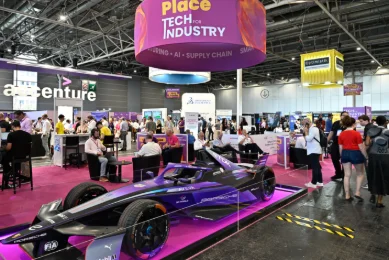
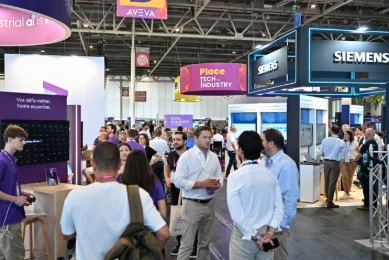
At Tech for Industry Show 2026, at Paris Expo Porte de Versailles, a round table on robotics brought together NVIDIA, Exotec, Michelin, Accenture and Dassault Systèmes. Its conclusion: move from coding a robot to training it, while keeping deterministic automation where it is needed, such as welding or assembly. Dassault Systèmes argued for simulation before the real thing: "Simulation is not cheating, it is preparing". Read the article
Frequently asked questions
What is a welding robot?
A robotic arm, most often with six axes, that carries a torch or a gun and makes welds according to a program, with the same parameters on every part.
Which processes can a robot weld?
MIG/MAG and TIG arc welding, spot welding, laser or hybrid laser welding, plasma and friction stir welding.
How much does a welding robot cost?
Hellopro reports 50,000 to 300,000 euros on average for a robotic cell in November 2026, and 25,000 to 90,000 euros for a new six-axis arm alone, excluding integration.
Welding robot or cobot: which to choose?
The robot in a cell for large repetitive series, the cobot for small varied batches, next to a welder who programs and supervises it.
What are the risks of robotic welding?
Welding fumes, classified as carcinogenic to humans since 2017, arc radiation and the mechanical hazards of the robot, covered by the ISO 10218-1 and ISO 10218-2 standards.
Further reading
Our industrial robotics page brings together the show's talks, articles and exhibitors on this topic.