PLM (product lifecycle management) brings together the methods and software that manage all the data of an industrial product, from its specifications to its end of life. It is the reference for the product definition: requirements, CAD drawings and models, bills of materials, versions and changes. ERP and MES take the released version to purchase, plan and manufacture.
What a PLM does in a manufacturing company
- Centralise product data: CAD models, technical documents, specifications, recipes or formulations, in a single base, with access rights for each department.
- Manage bills of materials: the engineering BOM (eBOM), which describes the product as designed, and often the manufacturing BOM (mBOM), which describes it as produced in a given plant.
- Manage changes: request, impact analysis, approval and release of a design change, with a history of who changed what.
- Manage configuration and variants: knowing which version of which part goes into which delivered product.
- Track requirements and compliance: standards, regulations, environmental data.
- Bring together engineering, manufacturing engineering, purchasing, quality, suppliers and after-sales on the same data.
PLM, PDM, ERP and MES: what is the difference?
- PDM (product data management) manages the design office's CAD files and technical documents. It is the ancestor of PLM and often its first building block.
- PLM extends this management to the whole lifecycle and the whole company: requirements, BOMs, changes, compliance, suppliers, after-sales.
- ERP manages production and the business: inventory, purchasing, planning, costs, invoicing. PLM creates and changes the BOM, the item master and the approved supplier list; ERP uses the released version. One does not replace the other.
- MES runs execution on the shop floor, in real time. Our MES guide covers this part.
How the manufacturing BOM is shared between PLM and ERP depends on the vendor and the chosen architecture. The key point is to name a master system for each piece of data, to avoid entering it twice.
Digital thread and AI
The digital thread links product data from one software tool to the next: requirement, design, simulation, manufacturing, service. It makes it possible to trace a defect reported by a customer back to the part, its BOM and the original requirement. It is also what gives an AI assistant the context of a specific product: without access to structured, versioned product data, its answers remain generic.
The market
According to the firm CIMdata, the global PLM market reached 88.3 billion dollars in 2025, up 9.9% on 2024 (press release of 04/06/2026). The figure rests on the broad definition of PLM used by this firm; other firms publish very different amounts.
What manufacturers said at Tech for Industry Show
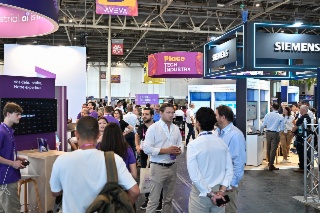
At Tech for Industry Show 2026, at Paris Expo Porte de Versailles:
- Transition Technologies PSC described three maturity stages that most of its customers follow: document management and CAD (PDM), then a collaborative PLM with BOM management, then an enterprise PLM linking design, production, suppliers, quality and after-sales. Example presented: an onshore wind turbine manufacturer that made PLM the foundation of its organisation to react quickly to an incident on a blade. Read the article
- Pernod Ricard and Danone, with Infor and Accenture, presented PLM as the source of product data in food and drink: recipes, formulations, packaging, specifications. At Pernod Ricard, the project is first a transformation of R&D processes, now a global function. At Danone, BOM integration started in one plant, then ten, before considering the other sites. Read the article
- Aras showed three uses of the digital thread: a late requirement change, the obsolescence of an electronic component and a field defect reported with a serial number. Read the article
- PTC and 9altitudes presented a three-step method: structure product data, ensure its continuity across CAD, PLM, ERP and MES, and only then add AI. Read the article
The food and drink round table is available as a replay: Rethinking innovation in the digital age.
Other examples in France
- Renault replaced in 2021 CATIA and ENOVIA V6, installed on its own servers, with Dassault Systèmes' 3DExperience platform hosted in the cloud: more than 5,500 users, 1,800 vehicles and variants, more than 500,000 components. The group describes a difficult migration at first (LeMagIT, 11/06/2024).
- Haulotte, an aerial work platform manufacturer, launched a new PLM with Aras in 2017, connected to its ERP and CAD software, for around 600 users in 150 countries; change management runs from marketing to manufacturing (LeMagIT, 14/04/2021).
How much does a PLM cost?
Most vendors quote prices on request: they depend on the number of users and their roles, the modules, compliance needs and integration with CAD and ERP. Two published examples, read on 04/11/2026:
- OpenBOM, a cloud offer, lists 30 dollars per user per month with annual billing for BOM management, and 90 dollars for the plan that adds CAD file and change management; read-only users are free.
- Odoo includes a PLM app in its plan that gives access to all its apps.
How to run a PLM project
1. Start from the processes: how the product is designed, sold (from catalogue, configured or engineered to order), manufactured and maintained.
2. Take stock of data and tools: CAD, shared files, spreadsheets, ERP, MES.
3. Name the master system for each piece of data (item, BOM, supplier).
4. Choose the vendor and the integrator, in the cloud or on premises.
5. Start small: one scope, one site or one product range, then extend.
6. Support the teams: a sponsor at the highest level, ambassadors in the field, training.
2027 exhibitors equipping PLM
To meet at Tech for Industry Show 2027:
- 4CAD PLM: integrator of design, simulation and product lifecycle management solutions, as well as ERP and MES.
- Aras Software: low-code PLM and digital thread platform.
- Koddex: engineering repository linking requirements, BOMs, impact analyses and compliance, for regulated industries.
- PTC: vendor of Creo (CAD) and Windchill (PLM).
- Transition Technologies PSC: PLM, IoT and augmented reality integrator.
Frequently asked questions
What is PLM?
Product lifecycle management: the methods and software that manage a product's data from its design to its end of life.
What is the difference between ERP and PLM?
PLM defines the product (BOMs, versions, changes); ERP manages its manufacturing and sale (inventory, purchasing, planning, costs) from the released version.
What is the difference between PDM and PLM?
PDM manages the design office's CAD files; PLM extends this management to the whole company and the whole lifecycle.
What are the main PLM software packages?
Among those mentioned in this guide: Siemens Teamcenter, Dassault Systèmes ENOVIA and 3DExperience, PTC Windchill, Aras, and cloud offers such as OpenBOM or Odoo.
Is PLM useful for an SME?
Yes, as soon as several people change the same drawings and BOMs; cloud offers billed per user exist for small teams.