Production flow simulation reproduces on a computer how a workshop, a line or a plant operates, so that changes can be tested before they are made: an extra machine, a new product mix, a different schedule. It almost always relies on discrete-event simulation, which moves time forward from one event to the next (a part arrives, an operation ends, a machine breaks down). A well-run study shows where the bottleneck is, what throughput to expect and which investment is worth making.
What discrete-event simulation is
In a discrete-event simulation, the state of the system changes through a sequence of events, each occurring at a given time. Between two events nothing changes, so the software jumps straight to the next event. This is what makes it possible to simulate weeks of production in a few seconds.
It differs from continuous simulation, where time is cut into regular steps, as when following a rising temperature. Software vendors also distinguish agent-based modeling, where overall behavior emerges from individual behaviors, and system dynamics, which works on aggregated quantities and cause-and-effect loops. For a production line made of workstations, queues, operators and conveyors, discrete-event simulation remains the basic method.
The model contains three things: resources (machines, operators, handling equipment), rules (routings, priorities, batch sizes, shift patterns) and variability (variable cycle times, breakdowns, scrap), described by probability distributions. The model is run and indicators are read: throughput, work in progress, utilization, lead time, buffer saturation.
What a flow simulation study is used for
Uses fall into three families:
- Design: sizing a new line or an extension, choosing the number of machines, buffer sizes, the number of mobile robots or forklifts.
- Improve: finding the bottleneck of an existing line, testing a new release rule, measuring the effect of shorter changeovers.
- Steer: comparing several production plans before launching them, which links simulation to production planning.
A spreadsheet is enough for an average capacity calculation. It does not capture the effects of variability: two machines at 80% average load can block each other if their breakdowns do not happen at the same time. This is what simulation shows, and what an indicator such as overall equipment effectiveness measures afterwards on the real line.
According to the French Wikipedia article on the method, carmakers have required since the 1990s a simulation study to approve any operational investment above a certain amount.
The steps of a study
The classic method, taught in simulation courses (for example at the University of Houston), follows nine steps:
- Define the problem: the question asked and the indicators that answer it. This is also when to check that simulation is the right tool.
- Plan the project: tasks, owners, milestones.
- Define the system: what goes into the model and at what level of detail.
- Formulate the model: a flowchart of how the real system works, with its variables.
- Collect and analyze data: cycle times, breakdowns, arrivals, fitted to probability distributions.
- Translate the model into the software.
- Verify and validate: verify that the model does what was intended, then validate that it reproduces the real system. A model can be verified without being valid.
- Experiment and analyze: run the scenarios and compare them statistically.
- Document and implement: present the results and the recommendation.
Two precautions come up in every study. A model that starts with an empty plant does not represent steady state, so a warm-up period is discarded before measuring. And because the model contains variability, a single run is not enough: the simulation is replicated several times and scenarios are compared with their confidence interval, not on a single value.
Data collection often takes the most time. At Michelin, before the tool described below, a new simulation required adjusting 65 tables and at least three weeks of data preparation.
Flow simulation software
The market has around ten commercial packages used in industry, many of them now part of large groups:
- Plant Simulation (Siemens, Tecnomatix portfolio): modeling, simulation and analysis of production systems and logistics processes. Siemens publishes offer levels limited to 500 objects (Essentials) and 4,000 objects (Standard).
- FlexSim: now sold as Autodesk FlexSim; the flexsim.com address redirects to the Autodesk website.
- AnyLogic (The AnyLogic Company): combines discrete-event, agent-based and system dynamics modeling.
- Simio (Simio LLC).
- Arena (Rockwell Automation).
- WITNESS: published by Lanner, acquired in January 2019 by the Dutch engineering group Royal HaskoningDHV.
- Simul8: acquired by Minitab, announced on 05/12/2024.
- ExtendSim: its publisher Imagine That Inc. has been a subsidiary of ANDRITZ since 01/02/2023; it is still sold to all customers.
- DELMIA (Dassault Systèmes) and Visual Components: 3D simulation of plants and robotic cells.
To choose, four questions matter more than the feature list: the size of the target models (number of objects), the availability of industry libraries (conveyors, mobile robots, storage), the connection to plant data (ERP, MES, planning files) and the skills available in-house or at a service provider.
Free options
- JaamSim: free, open source discrete-event simulation software under the Apache 2.0 license, for Windows, macOS and Linux, with a drag-and-drop interface and 3D graphics. A paid version, JaamSim Pro, adds transportation and bulk material libraries.
- SimPy: a Python discrete-event simulation library under the MIT license. It requires programming but fits with existing data and analysis scripts.
- Limited versions of commercial software: most vendors offer a trial, learning or student version, limited in number of objects or duration and often barred from commercial use. Conditions change from one version to the next: check them on the vendor's website before starting a project.
A spreadsheet still has a role: preparing input data and reading results. It does not replace a simulation engine as soon as variability matters.
Flow simulation and the digital twin
NIST, the US standards institute, describes digital twins as synchronized virtual models that help manufacturers represent, diagnose, predict and optimize their operations. ISO 23247-1, published in October 2021, sets the framework for the digital twin in manufacturing.
The difference lies in synchronization. A classic simulation study is an offline model, fed with historical data, run to compare scenarios. A digital twin stays connected to plant data and follows its state. In practice, the flow simulation model often becomes the core of a digital twin once it is fed automatically with production data and opened to site teams.
The Michelin case, published by Siemens, illustrates this shift:
- Michelin has worked with Plant Simulation since 2018, first at a site in Italy with partner Inoprod, then at four more plants in 2021.
- Since 2024, five new sites a year have adopted the model, with a low-code application, Optimize My Plant, which puts predefined scenarios in the hands of site managers.
- In a curing shop, turning the production plan into a schedule took between 4 hours and 2 days, sometimes a week; it is now done in one click.
- The uses cited range from balancing two automated warehouses in China to studying the removal of machines in Italy and spreading maintenance work.
Among the 2027 exhibitors at Tech for Industry Show, SPINALCOM publishes an operational digital twin platform that brings together OT data, IT data and technical repositories, and YZAR builds 3D digital twins of industrial facilities for training, maintenance and intervention preparation.
What manufacturers said at Tech for Industry Show
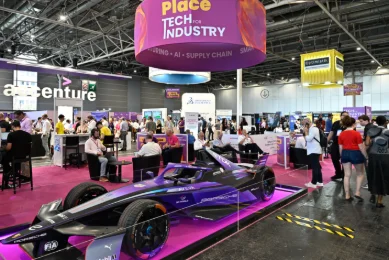
At Tech for Industry Show 2026, Renault Group and Accenture showed, in simulation, an agent queried in natural language about a production line: it identifies the current bottleneck, then another agent proposes solutions, such as adding an operator or cutting the cycle time of the previous station, which an operator approves. The report is in our article Renault digital twin: from data-driven plants to agentic AI.
Jean-Baptiste Pernot (ACC) presented digital tools as a necessity to manage the complexity of battery lines and shorten test cycles through simulation, and Pascal Bourcet (Siemens Digital Industries Software) the digital twin of production lines: ACC gigafactory: batteries, sovereignty and the Siemens digital twin.
On full-factory simulation for commissioning, see also our article Emulate3D and NVIDIA Omniverse: Rockwell Automation moves to full-factory simulation.
Frequently asked questions
What is production flow simulation?
It is the computer reproduction of how a workshop or a line operates, with its machines, operators, buffers and variability, to test changes before making them. It generally relies on discrete-event simulation.
Can flow simulation be done in Excel?
A spreadsheet is enough for an average capacity calculation and for preparing data. It does not reproduce the effects of variability, such as blocking between machines, which require a simulation engine.
Is there free flow simulation software?
Yes: JaamSim, open source under the Apache 2.0 license, and the Python library SimPy, under the MIT license. Commercial vendors also offer limited versions, often reserved for learning.
What is the difference between flow simulation and a digital twin?
A simulation study is an offline model run on scenarios. A digital twin stays synchronized with plant data. A flow simulation model can become the core of a digital twin when it is fed automatically.
How long does a simulation study take?
It depends on the size of the system and the quality of the data, which often takes the most time. At Michelin, preparing the data for a new simulation alone took at least three weeks before automation.
Further reading
- The Digital twins and simulation theme at Tech for Industry Show