Industrial supervision lets operators monitor and control a facility in real time from a screen: machine status, alarms, trends, setpoints. It relies on SCADA software connected to the shop floor PLCs. It differs from MES, which manages production orders, quality and traceability. Vendors range from Siemens, AVEVA or Inductive Automation to the French vendors PcVue and Codra, and open source software exists for small projects.
Industrial supervision: what it covers
ANSSI, the French national cybersecurity agency, defines SCADA (Supervisory Control And Data Acquisition) as the set of IT resources that allow operators and control technicians to supervise and control, remotely or locally, the technical facilities of one or more sites. It notes that outside Europe, the term often refers to a wider system that also includes PLCs, sensors and actuators.
Three terms come up:
- The HMI (human-machine interface): the control screen of a machine, often a panel placed next to it.
- SCADA: the software that collects data from several PLCs and displays it on supervisory workstations, for a line, a plant or several sites.
- Hypervision: a layer above several SCADA systems, giving a consolidated view of several plants or several activities.
What supervision software does
- Mimic diagrams: graphical views of the facility, showing the live status of machines and sensors.
- Alarms: detection of a fault or a threshold breach, display, acknowledgement by the operator, and often notification of on-call teams by text message or email.
- Historisation: recording values over time (temperatures, pressures, rates) in a historian, to plot trends and analyse an incident.
- Control: sending setpoints to PLCs, starting or stopping a sequence.
- Reports: production or energy consumption summaries, generated from the history.
- Web and mobile access: recent software displays its screens in a browser, on a tablet or on a phone.
To talk to PLCs, SCADA uses industrial protocols: OPC UA, Modbus, Siemens S7 or MQTT. Siemens states, for example, that WinCC Unified connects directly to S7 controllers, to other brands' systems via Modbus, and exchanges data with IT via OPC UA, MQTT or GraphQL.
Supervision and MES: where the boundary lies
The IEC 62264 standard (known as ISA-95) splits the plant into levels. It describes level 3, manufacturing operations management, and its exchanges with level 4, business management (ERP). Levels 3, 2 and 1 form the operations and control domain. SCADA sits at level 2: it controls the process in real time. MES sits at level 3: it launches production orders, tracks quality and traces batches.
In products, the boundary is less clear. AVEVA presents its System Platform as a platform for deploying SCADA, MES and IIoT applications, and Codra describes its Panorama suite as a SCADA, historian and MES platform. The role of an MES and how to choose one are covered in our mes software guide.
The data collected by supervision then feeds analytics and AI, as explained in our article on industrial data.
The main SCADA software vendors
Examples taken from the vendors' official pages, read on 17/11/2026, in no particular order:
- Siemens: SIMATIC WinCC Unified, an HMI and SCADA platform running from panel to PC, with HTML5 web clients.
- AVEVA: InTouch HMI, with an HTML5 web client requiring no installation on tablets and phones and an integrated historian, and System Platform for multi-site architectures.
- Inductive Automation: Ignition, sold per server with unlimited tags and clients, according to its price list.
- COPA-DATA (Salzburg, Austria): zenon, a platform for engineering and operating production and infrastructure equipment; the vendor describes itself as independent and claims more than 5,000 customers.
- ARC Informatique (Boulogne-Billancourt, France, founded in 1981): PcVue, a supervision platform that scales from a single workstation to hundreds, on premises, in the cloud or on mobile. The company is IEC 62443 certified, according to its page.
- Codra (France): Panorama Suite, covering SCADA, historian and MES. Codra states it was the first vendor to obtain ANSSI CSPN certification for a SCADA, in 2019; its current certificate, ANSSI-CSPN-2026/11, signed on 17/06/2026, is valid for three years.
- Schneider Electric, Rockwell Automation (FactoryTalk) and Velotic (iFIX and Simplicity, from GE) also offer supervision software.
How much does SCADA software cost
Most vendors do not publish their prices: the quote depends on the number of tags, workstations and modules. Inductive Automation is an exception. Its price list, read on 17/11/2026, gives estimates excluding taxes in US dollars, for a single licence:
- the Ignition platform: $1,200;
- the Perspective web and mobile visualisation module: $11,225;
- the Vision desktop visualisation module: $8,330;
- the Application Building suite (SCADA, HMI, reporting): $13,500;
- the Alarm Management suite: $3,200.
At AVEVA, InTouch is offered as a perpetual licence (InTouch Unlimited) or as a subscription (InTouch Unlimited Premier, Flex offer). A project budget also includes integration, often handled by a system integrator, training and annual maintenance.
Free or open source supervision software
- Rapid SCADA: an open source platform; the Community edition is free, with no limit on data points and no expiry date. Commercial editions (Standard, Enterprise, Embedded) add modules.
- FUXA: web-based SCADA and HMI under the MIT licence, supporting Modbus, OPC UA, MQTT and Siemens S7, with a historian on SQLite or InfluxDB.
- Scada-LTS: an open source, web-based solution under the GPL-2.0 licence.
- Ignition Maker Edition: free, up to 10,000 data points and 10 sessions, but restricted to personal or educational projects, so not for a plant. Ignition also offers a free trial of its full version.
Open source software suits a test bench, a small installation or a pilot project. For a production line, check who provides support, security updates and continuity if the person who configured it leaves.
Supervision and cybersecurity
The supervisory workstation is a target: it sees the whole shop floor and can send commands. The ANSSI guide "Cybersecurity for industrial control systems: detailed measures", version 2.0 of 27/11/2025, notes that the same workstations are often used for updates, development and operation of SCADA applications, and that engineering stations sometimes serve as supervisory consoles. Its recommendations include:
- installing SCADA servers in locked rooms with access control;
- not using supervisory stations for office applications or reading PDFs, and providing other workstations for that;
- disabling integrators' and equipment makers' debugging functions on supervisory applications;
- placing safety checks, such as verifying that a setpoint stays within its limits, in the PLC rather than in the HMI, which is easier to modify unnoticed.
The supervisory network is separated from the rest by an industrial firewall. Known attacks and SCADA-specific protections are covered in our scada security guide.
How to choose supervision software
- Start from the scope: one machine, one line, one plant or several sites. The number of tags and workstations often sets the price.
- List the PLCs and their protocols: check that the software reads them directly or via OPC UA.
- Look at the licensing model: perpetual or subscription, per tag, per workstation or per server, cost of modules and maintenance.
- Require web access if teams need to view supervision on a tablet or from another site.
- Check security: IEC 62443 certification of the vendor or the product, and ANSSI CSPN for sensitive sites.
- Think about the integrator: their knowledge of the software matters as much as the product, and they will often provide maintenance.
- Prepare for what comes next: an open historian and a connection to the MES, the ERP or a data platform avoid rebuilding everything later.
What manufacturers said at Tech for Industry Show
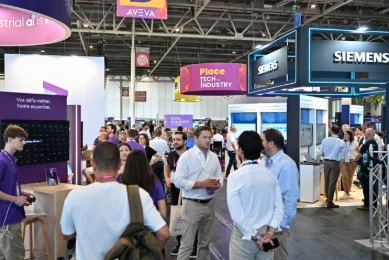
At the 2026 show, Laurent d'Izarny-Gargas (Velotic) pointed out that a SCADA can generate tens or even hundreds of alarms per minute during an incident. He presented an AI layer placed above the SCADA, without replacing it, which organises data from several sites, links alarms together and can generate a control screen. Read the article
At the round table on IT/OT convergence, Groupe Bel explained that it runs a fleet of 4,000 to 6,000 PLCs of all brands, and has deployed an edge platform in each plant to expose every machine in the same format, whatever its brand. Read the article
Frequently asked questions
What is industrial supervision?
Running a facility from a screen: real-time monitoring of machines, alarms, history and sending setpoints, using SCADA software connected to the PLCs.
What is SCADA?
Supervisory Control And Data Acquisition: the software that collects PLC data and lets operators supervise and control the facilities of one or more sites.
What is the difference between SCADA and MES?
SCADA controls the process in real time (level 2 of IEC 62264). MES manages production (level 3): production orders, quality, traceability.
What is the difference between HMI and SCADA?
The HMI is the control screen of one machine. SCADA brings together data from several machines or a whole plant on supervisory workstations.
Is there free industrial supervision software?
Yes: Rapid SCADA Community, FUXA and Scada-LTS are open source. Ignition Maker Edition is free but restricted to personal or educational projects.
How much does SCADA software cost?
Few vendors publish prices. At Inductive Automation, the Ignition platform is listed at $1,200 excluding taxes and a visualisation module between $8,330 and $11,225 (prices read on 17/11/2026), excluding integration.
Further reading
Our industrial software page brings together the show's talks, articles and exhibitors on industrial software: MES, ERP and PLM.