Visiting Airbus in Toulouse on 23/11/2026, Emmanuel Macron announced the creation of industrial zones where procedures will be simplified to speed up the opening of plants, according to AFP as carried by France 24. He also confirmed that €350 million will be ring-fenced for CORAC, the French civil aviation research council. The visit was part of the Choose France summit dedicated to French companies.
What the president announced
- High-potential industrial zones: the state and the regions will handle land and site grid connection by running all procedures in parallel, with the goal of being the fastest in Europe. The president cited data centers as an example.
- A lead time already cut: according to Emmanuel Macron, the time needed to create an industrial site has fallen from 17 to 10 months in four years, and things must move faster in the face of decarbonization and competition, especially from China.
- €350 million for aviation research: the CORAC budget is ring-fenced. It is also meant to strengthen the resilience of value chains in critical areas where France has dependencies, and to secure the supply of semiconductors.
The list of zones, their criteria and their timetable have not been specified.
The context: Choose France and €15 billion of projects
According to AFP, the summit showcases more than 200 industrial projects and nearly €15 billion of new investment by French companies in France. Among them, the Lyon-based SME Elyse Energy is presenting a plan for a sustainable aviation fuel plant in the Pyrénées-Atlantiques, valued at €1.6 billion. In late October, in La Tribune, Olivier Andriès, CEO of Safran and chairman of Gifas, pointed out that part of the CORAC money goes to French mid-sized companies and SMEs in the sector.
What it changes for a manufacturer
- A plant project depends on land and grid connection: securing ready land and enough electrical capacity often sets the start date of a site. Handling these two points in parallel rather than one after the other can save several months. A manufacturer preparing an extension or a new plant should follow the list of zones as soon as it is published, and talk to its region.
- The aerospace sector keeps its research budget: the €350 million for CORAC funds research in the sector, part of which flows down to mid-sized companies and SMEs, according to the chairman of Gifas. Subcontractors working on processes, materials or embedded electronics are concerned.
- Semiconductors become part of supply security: the president explicitly links CORAC to component supply, which confirms that electronics purchasing is becoming a sovereignty issue.
Our reindustrialization guide covers the figures and levers. Support schemes for new plants already exist: our article on the Première Usine call for projects presents its latest France 2030 winners, and our article on Renault and the France Industrie FutuREady plan shows the other bottleneck of a plant, hiring.
What manufacturers said at Tech for Industry Show
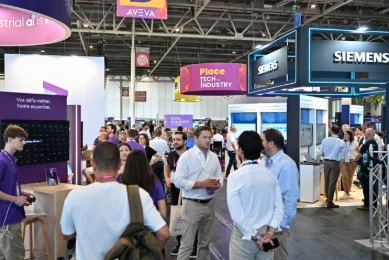
At Tech for Industry Show 2026, the round table on the defense industry raised the same question of speed. For the DGA, all the ingredients are there and it is a matter of timing to accelerate and scale up; Thales felt the sector was too slow compared with neighbors moving faster. Speakers also stressed the need to finance tier 2, 3 and 4 SMEs quickly enough. Read the article
Frequently asked questions
What are the industrial zones announced by Emmanuel Macron?
High-potential zones where the state and the regions will run land and grid connection procedures in parallel, to speed up the opening of plants.
Where will these industrial zones be?
The list had not been published as of 24/11/2026.
What is CORAC?
The French civil aviation research council, which structures research in the sector. €350 million is ring-fenced for it.
How long does it take to create an industrial site in France?
According to Emmanuel Macron, the time has fallen from 17 to 10 months in four years.