Reindustrialization means bringing industrial activity back to a country that had lost it: factories opening or expanding, production being relocated, industrial jobs coming back. Industrial sovereignty is the goal: being able to produce what the country needs, in energy, health, food or defense, without depending on a single foreign supplier. In France, the movement is real but slowing: according to the French government's industrial barometer, the net factory balance remained positive in 2025 (+19), compared with +88 in 2024.
Reindustrialization, reshoring, sovereignty: what are we talking about?
- Reindustrialization: giving industry a greater weight in the economy of a country or region after decades of deindustrialization. It happens through new factories, the expansion of existing sites and reshoring.
- Reshoring: bringing back to France all or part of a production that had been moved abroad. It is one way to reindustrialize, not the only one.
- Industrial sovereignty: the ability to secure the supply of essential goods and inputs. The French Senate, in its report "Cinq plans pour reconstruire la souveraineté économique" (Five plans to rebuild economic sovereignty, July 2022), takes this angle and considers that complete economic independence is neither feasible nor desirable: the point is to choose one's dependencies, not to produce everything.
There is no single official definition of these terms: the definitions above are the ones used in this guide.
Where does reindustrialization stand in France?
The factory balance
Openings and expansions of factories, minus closures and downsizings:
- 2024: +88 (French government industrial barometer, DGE, 29/03/2026)
- 2025: +19 (French government industrial barometer, DGE, 29/03/2026)
In 2025, expansions of existing sites (158 significant expansions) kept the balance positive. The sectors that grew were defense, aerospace and space (+19) and electronics (+12); transport, chemicals, mechanical engineering and metallurgy declined (DGE, press release no. 496, 29/03/2026).
The figure depends on what is counted. Trendeo, which does not count expansions, reports a balance of -63 factories for 2025 (quoted by Banque des Territoires, 30/03/2026). The two figures do not contradict each other: they measure two different things.
The weight of industry in the economy
- Manufacturing accounts for 10.8% of value added in France, compared with 19.8% in Germany and 16.0% in Italy, in the first quarter of 2025 (French Treasury, 05/09/2025). The Treasury notes that the German measure includes industry-related services, which inflates its share.
- French manufacturing output reached 981 billion euros in 2025, up 1.2% in volume year on year (Insee, 21/07/2026).
- Manufacturing employed 3.1 million people in 2022, around 11% of employment in metropolitan France (France Stratégie, 12/07/2024).
Public policies
- France 2030: an investment plan of around 54 billion euros. As of 30/06/2025, 40 billion had been allocated and 14 billion paid out, to 5,500 beneficiaries (French Senate, general report no. 139, 2025-2026).
- Green Industry Act (enacted on 23/10/2023): it aims to speed up reindustrialization and make France a leader in green industry in Europe. Its main measure for manufacturers: halving the time needed to set up a factory, described as the first obstacle by the manufacturers consulted; it also provides for the rehabilitation of brownfield sites and a simplified procedure for projects of major national interest (French Ministry of the Economy).
- EU Net-Zero Industry Act (Regulation (EU) 2024/1735): it sets the goal for the EU to manufacture 40% of its annual needs in net-zero technologies by 2030 (solar, wind, batteries, heat pumps…), and shortens permitting procedures for these factories (EUR-Lex).
What holds it back
France Stratégie estimated what a scenario in which manufacturing rises back to 12% of value added in 2035 would require ("Réindustrialisation de la France à l'horizon 2035", 12/07/2024):
- land: 23,000 to 30,000 additional hectares;
- skills: an increase of more than 30% in the need for engineers, managers and researchers;
- energy: higher electricity consumption, difficult to cover with low-carbon electricity before new reactors come online.
On top of this comes dependence on inputs: the share of imported industrial inputs rose from about 29% to about 40% in twenty years, according to the French Senate (2022 report).
What manufacturers say
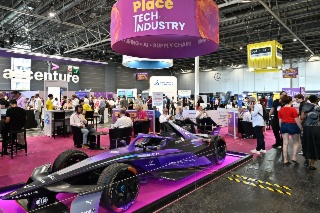
At Tech for Industry Show 2026, at Paris Expo Porte de Versailles, several manufacturers described how they reindustrialize in practice.
- Reshoring through automation. In his keynote, Aymeric Renaud presented an assembly line that required 20 operators, reshored to France with 3 operators thanks to automation and AI-based visual inspection, at a cost comparable to Asia. He also presented low-carbon electricity as the main asset of French factories. Read the article
- Building the plant is only the beginning. For Jean-Baptiste Pernot (ACC, batteries), construction is only about 20% of the challenge: the main part is the ramp-up, with scrap rates at world standards. ACC mentions a production cost gap of about 30% with China. Read the article
- Grid connection, the new bottleneck. For RTE, the issue is less the price of electricity than connection lead times: the grid operator faces 33 GW of connection requests. Read the article
- From design to production. In defense, the DGA, Naval Group, Thales, Accenture and Saft described the same shift: producing more and faster, with three bottlenecks: recruitment, financing and the supplier chain. Read the article
- Financing new factories. Bpifrance, France Digitale and Crédit Agricole reviewed industrial start-ups and the transformation of SMEs, slower than that of large groups. Read the article
- Sovereignty also goes through digital. Dassault Aviation sums up a company's digital sovereignty in two requirements: not depending on foreign laws for its digital tools, and continuing to operate in a crisis. Read the article Thales, SAP and S3NS presented their move to a SecNumCloud-certified cloud. Read the article
The conferences can be watched as replays: Tech and industry, a decisive alliance in the global battle, French defense industrial sovereignty, Digital sovereignty for industrial players.
Frequently asked questions
What is reindustrialization?
It is the return of industrial activity to a country that had lost it: factory openings and expansions, reshoring, growth in industrial employment.
Is France reindustrializing?
Yes, but more slowly: the factory balance fell from +88 in 2024 to +19 in 2025 according to the French government, driven by site expansions. Without counting expansions, Trendeo measures a negative balance in 2025.
What is the difference between reindustrialization and reshoring?
Reshoring brings back a production that had been moved abroad. Reindustrialization is broader: it also includes new factories and the expansion of existing sites.
What is industrial sovereignty?
It is a country's ability to secure its production and its supply of essential goods. It does not mean producing everything at home, but reducing the riskiest dependencies.
What is France 2030?
A public investment plan of around 54 billion euros for industry and innovation. As of 30/06/2025, 40 billion had been allocated.
Meet the manufacturers who are reindustrializing
On 19 and 20 May 2027, at Paris Expo Porte de Versailles (hall 7.1), Tech for Industry Show brings together decision-makers from industrial companies and the software vendors, integrators and start-ups that build their tools.