On 12/11/2026 Veolia opened a plant in Moselle, eastern France, that processes black mass, the black powder obtained by shredding used batteries, to extract cobalt, nickel and copper. According to Veolia's press release, the process recovers over 90% of these three metals and the site will be able to handle nearly 7,000 tonnes of black mass a year, the equivalent of 20,000 tonnes of batteries. According to AFP, as published by Boursorama, the plant is located on the outskirts of Amnéville, in Malancourt-la-Montagne.
What Veolia announced
- The process: hydrometallurgy technologies developed by Veolia. According to AFP, chemical reagents dissolve the metals contained in the powder.
- Supply: the black mass comes from Europe, so far from France, the United Kingdom and Switzerland. The batteries are dismantled at another plant an hour's drive away, AFP adds.
- Outlets: the metals are sold to the European automotive, construction and defence markets. In the longer term, and with public support, Veolia is aiming at battery manufacturing in Europe.
- The market: Veolia estimates that nearly 700,000 tonnes of batteries will need recycling in Europe within five years, representing more than one billion euros of metals.
- Next steps: other battery dismantling projects are under way in the United Kingdom, Belgium and Slovenia, upstream of this site.
What it changes for a manufacturer
Until now, much of the black mass produced in Europe went to Asia for refining. Veolia says so in its press release: competition from outside Europe is driving massive exports of this powder to Asia. Three effects matter for manufacturers:
- For metal buyers: carmakers, metalworkers and the defence industry gain a European source of recycled cobalt, nickel and copper. The volume remains modest compared with the market Veolia describes.
- For those who generate battery waste: according to AFP, Stéphane Séjourné, Executive Vice-President of the European Commission, confirmed at the opening that the Union will ban black mass exports to countries outside the OECD. China and India are concerned, but not South Korea, which is a member. A carmaker, battery maker or recycler that sells its black mass therefore needs to review its outlets.
- For the battery-to-battery loop: it remains a long way off. AFP points out that Europe lacks plants for cathode precursors, the materials that turn these metals into battery components, which are almost all produced in Asia today. Veolia also finds it hard to compete with Asian buyers who pay above-market prices for black mass.
The site is part of the reindustrialisation drive around critical materials. Another link in the battery chain is being built in Gironde with the EMME project in Parempuyre. Our industrial decarbonisation page brings together the show's talks, articles and exhibitors on this topic.
What manufacturers said at Tech for Industry Show
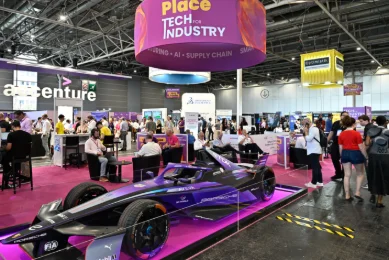
At Tech for Industry Show 2026, Jean-François Nogrette (Veolia) argued for a sovereignty based on the "urban mine", the materials already present in waste. He pointed out that France sorts its waste but exports a large share of it, including 80% of sorted nickel and 70% of sorted copper. He also said that end-of-life batteries will grow from a few thousand tonnes to more than one million tonnes in 2035, while metallurgy still goes to Asia. Read the article
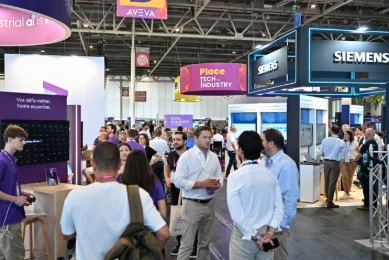
At the same edition, ACC and Siemens presented the levers of the European battery industry. Read the article
Frequently asked questions
What is black mass?
It is the black powder obtained by shredding used batteries. It contains the battery's metals, including cobalt, nickel and copper.
Where is Veolia's plant?
In Moselle, on the outskirts of Amnéville, in Malancourt-la-Montagne according to AFP. It opened on 12/11/2026.
How much does the plant process?
According to Veolia, nearly 7,000 tonnes of black mass a year, the equivalent of 20,000 tonnes of batteries, with over 90% of the cobalt, nickel and copper recovered.
Are black mass exports outside Europe banned?
According to AFP, Stéphane Séjourné confirmed on 12/11/2026 that the European Union will ban its export to countries outside the OECD.