A manufacturing ERP is an integrated management software package built around production: it brings sales, purchasing, inventory, production planning, quality and finance together in a single database. What sets it apart from a general-purpose ERP is its central production management module (MRP), which calculates what needs to be bought and made, and when. In France, 65% of manufacturing companies with 10 or more employees used an ERP in 2025.
Manufacturing ERP: definition
ERP stands for enterprise resource planning. An ERP has two defining features: it gives every function of the company a single, consistent view of its data, and it covers all of its processes across departments. Before ERP, applications of various origins coexisted, shared little data and required hand-built interfaces.
Manufacturing ERP descends directly from production planning:
- in the 1960s, Joseph Orlicky studied Toyota's production schedule and designed MRP (material requirements planning), which calculates material requirements;
- MRP II (manufacturing resource planning), later developed by Oliver Wight and George Plossl, adds release planning based on resource capacity;
- in the 1990s, the logic extended to every function of the company: this is ERP, whose growth was also driven by the replacement of ageing systems.
Production management software is therefore called, depending on its scope, a production management system or a manufacturing ERP, when it is integrated with the management of the whole company.
The modules of a manufacturing ERP
A manufacturing ERP rests on a central production management module, around which the other functions are added:
- planning and scheduling: production plan, net requirements calculation, release of production orders;
- production tracking and traceability: what was produced, with which material lots;
- inventory and procurement: raw materials, components, semi-finished goods;
- subcontracting, maintenance and quality;
- sales, purchasing and finance, common to every ERP.
Requirements calculation relies on two pieces of master data: the bill of materials (what the product is made of) and the routing (the operations to make it). Their accuracy conditions everything else: an ERP working from a wrong bill of materials orders the wrong parts. The calculation, from the sales and operations plan to MRP, is explained in our guide Production planning.
ERP, MES, PLM, WMS: who does what in the plant
ERP manages the company and works in days or weeks. It does not see what is happening on a machine, and it does not manage product design. It therefore relies on other software:
- MES manages execution on the shop floor: it receives production orders from the ERP and returns the quantities produced and consumed. The difference is explained in our guide MES software;
- PLM manages the product definition through design and changes, and passes the bill of materials to be produced to the ERP (PLM guide);
- WMS manages the warehouse in detail, location by location, when the ERP's inventory module is no longer enough (WMS guide).
A "logistics ERP" usually means an ERP whose inventory, purchasing and shipping modules are rich enough to do without a separate WMS.
How many manufacturers are equipped
According to the European survey on ICT usage in enterprises (Eurostat, 2025 data, companies with 10 or more employees):
- 65% of French manufacturing companies use an ERP, compared with 58% in the European Union;
- across all sectors in France, the share ranges from 49% of small companies (10 to 49 employees) to 80% of medium-sized ones (50 to 249) and 93% of large ones (250 or more);
- ERP is the most widely used business software in the EU, ahead of customer relationship and data analysis tools.
In other words, a third of manufacturers with 10 or more employees still run without an ERP, usually with accounting software and spreadsheets.
E-invoicing: a French deadline that runs through the ERP
The French reform of business-to-business e-invoicing came into force on 1 September 2026:
- since 1 September 2026, all companies must be able to receive electronic invoices; large and intermediate-sized companies must also issue all their invoices electronically and report their transaction data to the tax authority;
- from 1 September 2027, the obligation to issue extends to small and medium-sized companies and micro-enterprises.
For a manufacturer, it is the ERP that produces invoices: it must be able to issue and receive them in an accepted format, connected to an approved platform. This is a concrete selection criterion for an SME changing ERP before September 2027.
Cloud or on-premise
ERPs are now deployed in three ways:
- on-premise, installed on the company's own servers, which keeps control and the workload;
- private cloud, hosted and run by the vendor or a provider, with a version specific to the company;
- public cloud (SaaS), shared between customers, updated by the vendor several times a year, which requires following the software's standard processes.
The choice depends on how many processes are specific to the company, its data sovereignty requirements and its in-house IT resources.
What manufacturers said at Tech for Industry Show
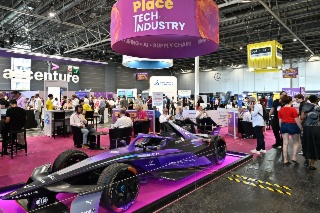
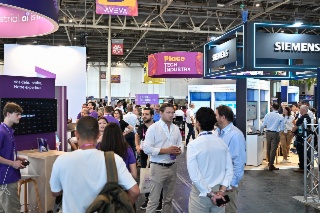
At Tech for Industry Show 2026, at Paris Expo Porte de Versailles:
- Le Triangle group, a family-owned mid-sized company with 1,000 employees and 450 million euros in revenue in photovoltaic buildings, reworked its processes before choosing its ERP. Starting point: around a hundred separate management databases, with no shared customer, supplier or item master data, and most processes never written down. The group chose a public cloud ERP, following the software's standard practices as far as possible, and a simultaneous go-live across its 13 operating companies, as its highly integrated projects do not lend themselves to a phased roll-out. Its transformation director also sees it as the condition for adding AI later on clean data. Read the article
- Exide Technologies, a battery manufacturer, had failed three or four times to replace its legacy ERP. The next selection went from ten ERPs to three, then to one, chosen for the depth of its manufacturing functions. The principle: adopt the standard, adding only each country's accounting specifics, with a roll-out spread over four years, from the Nordic countries and Poland in June 2024 to all countries in 2028. Read the article
- SKF Magnetic Mechatronics, which ran three different ERPs inherited from acquisitions, is unifying its sites on a single one. It started with its newest and smallest sites, where resistance to change is lower: in Morocco, order entry, purchasing, receiving and quality went live in under three months, on a broad but shallow scope, then extended as the site grows. Read the article
The talks can be watched again as replays: Le Triangle group: lessons learned from an industrial digital transformation, ERP and PLM: how AI introduces a new performance lever.
The 2027 exhibitors offering or integrating an ERP
To meet at Tech for Industry Show 2027 (in alphabetical order):
- 4CAD Group: integrator of PLM, ERP, MES and CRM solutions for industry.
- IFS: publisher of a modular platform covering ERP, asset and service management, with built-in AI.
- Neptune Software: a platform for building applications and AI agents connected to the SAP ERP.
How to choose and deploy a manufacturing ERP
1. Write down processes before choosing the tool: orders, purchasing, production, shipping, invoicing, and who is responsible for what.
2. Clean up master data: items, bills of materials, routings, customers and suppliers, in a single repository.
3. Choose according to your business: make-to-order or make-to-stock, batch or continuous production, traceability required by your sector.
4. Check the exchanges with MES, PLM and WMS, and compliance with e-invoicing.
5. Decide how far to follow the standard: every custom development costs again at every upgrade.
6. Choose the go-live approach: all sites together, or a pilot site first, depending on how integrated the companies are.
7. Train and support people: an ERP changes how the whole company works, not just its IT.
Frequently asked questions
What is a manufacturing ERP?
An integrated management software package whose core is production management: requirements calculation, production orders, inventory, quality, linked to sales, purchasing and finance.
What is production management software called?
It is often called a production management system or MRP system. Integrated with the management of the whole company, it becomes a manufacturing ERP. Shop-floor execution is the job of MES.
What is the difference between ERP and MES?
ERP plans at company level, in days or weeks; MES manages and records what happens on the shop floor, in real time. MES receives orders from the ERP and returns what was produced.
What is a logistics ERP?
An ERP whose inventory, purchasing and shipping modules cover the company's logistics needs. Beyond a certain warehouse volume, a WMS is added.
How long does an ERP project take?
It depends on the scope. Manufacturers who spoke at the show mention a few months for a first scope on a small site, and several years for a roll-out across every country of a group.
Is an ERP mandatory for e-invoicing in France?
No, but companies must be able to receive electronic invoices since 1 September 2026 and, depending on their size, issue them since that date or from 1 September 2027. For a manufacturer, the ERP usually handles this.